
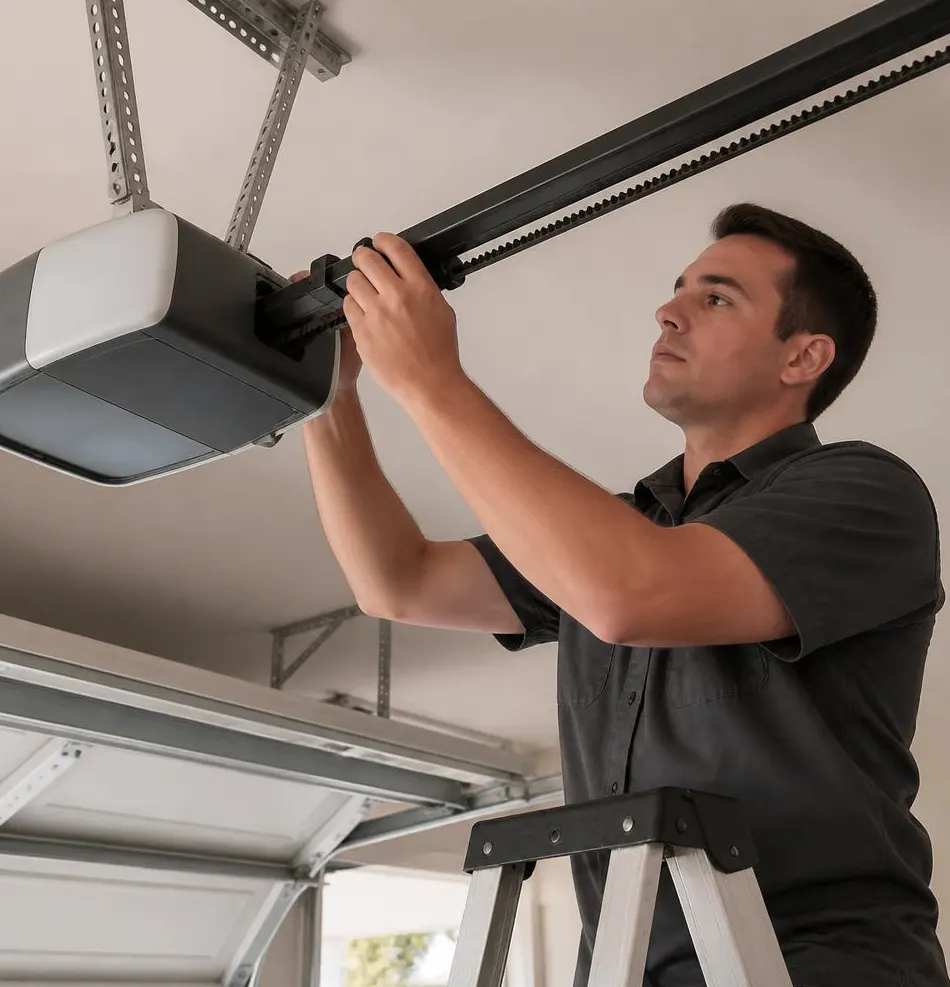
A garage door that fails during a storm rarely fails quietly. Wind gets behind it, the door buckles or blows inward, and suddenly the whole house is pressurized like a paper bag. Roof decking lifts, soffits tear loose, and insurance adjusters start asking why the door wasn't rated for the wind it saw. Skip the inspection this season and you're not risking a cosmetic dent — you're risking the one failure point that can take the rest of the structure with it.
Why the Garage Door Is a Home's Weakest Wall
Every other exterior wall in a typical house is a solid, continuous surface. The garage door is a large panel of moving parts — hinges, rollers, a track system, and springs — held in place by hardware that was often sized for convenience, not for a sustained 100+ mph gust. When wind hits a closed house, pressure builds. If the garage door gives way first, that pressure has nowhere to go but up, which is why so much hurricane roof damage traces back to a door that blew in or buckled outward.
Standard, non-reinforced doors built for mild weather simply weren't engineered for wind-load requirements. In coastal Pinellas County, where afternoon storms are routine for half the year and tropical systems are a real possibility, that gap matters a lot more than it would inland.
Symptoms That Your Door Won't Hold Up
- Visible flex when the door is closed and you push on it from inside — a sign the panels and bracing aren't stiff enough for sustained wind pressure.
- Rollers or hinges that have started to rust or pit from salt air exposure, which weakens the connection points exactly where storm stress concentrates.
- Tracks that are bent, loose, or not fully anchored to the framing — a track that pulls away under normal use will fail faster under wind load.
- Springs that are original to the house or clearly sagging, since a spring under extra strain from wind is far more likely to snap, which can let the door drop or slam during a storm.
- An opener with no manual lock engaged, meaning the door relies entirely on the opener's resistance instead of a mechanical lock to stay shut under pressure.
What Actually Holds a Door in Place During High Wind
Bracing and Reinforcement
Horizontal or vertical bracing kits stiffen the panels so they can't bow inward or outward under pressure. These are typically bolted to the inside of the door and tie into the framing, and they're one of the most cost-effective upgrades available — national pricing for retrofit bracing kits generally runs in the low hundreds of dollars, far less than storm-related structural repair.
Track and Hardware Condition
Even a well-built door will fail if the track pulls loose from the wall. Lag screws loosen over time with humidity and temperature swings, and salt air accelerates corrosion on exposed hardware near the coast. Tracks need to be checked for tight, rust-free anchoring, not just visual straightness.
Spring Balance
A door that's out of balance puts uneven stress on the opener and the panels every time it moves, and that stress compounds when wind is pushing against it. A door should lift smoothly and hold its position halfway open when disconnected from the opener — if it drifts up or crashes down, the springs are no longer doing their job correctly.
Opener Backup and Manual Locks
During a power outage — common once storms knock out lines across the county — a door with no manual lock is only as secure as friction and gravity allow. A functioning manual slide lock, engaged before a storm, keeps the door from being forced open even without power.
A Pre-Storm Checklist
- Inspect panels for flex, cracks, or soft spots from moisture intrusion.
- Check all hinges, rollers, and track bolts for rust or looseness and replace corroded hardware before it fails.
- Test spring balance by disconnecting the opener and lifting the door halfway — it should hold, not drop or fly up.
- Confirm the manual lock engages fully and isn't rusted shut.
- Add or inspect existing bracing kits, especially if the door predates current wind-load expectations.
- Clear tracks of salt residue and grit, then lubricate moving parts to prevent binding when humidity swells the wood or metal.
None of this is a one-and-done job. Salt air, heat, and the daily cycle of afternoon downpours followed by sun keep working on hardware year-round, so a door that passed inspection last year can develop a weak point by the time the next storm system moves through the Gulf.
When to Call Belleair Beach Overhead Door Co
If you push on your door and feel it give, hear new creaking from the springs, or notice the track pulling away from the frame, that's the point to get it looked at before a storm — not during one. Our Garage Door Tune-Up & Maintenance service covers the full inspection above: hardware, balance, track alignment, and lubrication, with corrosion-prone parts flagged and replaced before they become a failure point. If your springs are original or clearly sagging, our Garage Door Spring Repair service restores proper balance so the door isn't carrying extra strain the day wind actually tests it.
We serve homeowners throughout Belleair Beach, Belleair Bluffs, Belleair, Indian Rocks Beach, Largo, Clearwater, Clearwater Beach, and Seminole, and we'd rather catch a weak spring or a rusted track in October than get the call after a storm has already made the decision for you. Call Belleair Beach Overhead Door Co today to get your door checked before the next system rolls in.